Transform your org with innovative, secure, cloud-native AI solutions today.. CONTACT US
Founder
June 21, 2026
Digital content management (DCM) is the end-to-end process of creating, organizing, delivering, and governing digital assets—including text, video, and graphics—across platforms.
At enterprise scale, DCM intersects with media asset management (MAM)—a specialized discipline designed to handle high-volume, time-based media such as video, audio, and complex creative assets.
For UK enterprises operating across fintech, media, retail, and public sector ecosystems, modern architectures are shifting toward decoupled, API-first systems—enabling omnichannel delivery, cloud scalability, and real-time content workflows.
Traditional CMS platforms tightly couple content with presentation layers. While this works for basic publishing, it breaks down in distributed environments.
Modern headless DCM systems:
Separate content from frontend rendering
Deliver content via APIs (REST / GraphQL)
Support omnichannel distribution (web, mobile, OTT, apps)
This allows organizations to scale content operations without rearchitecting frontends.
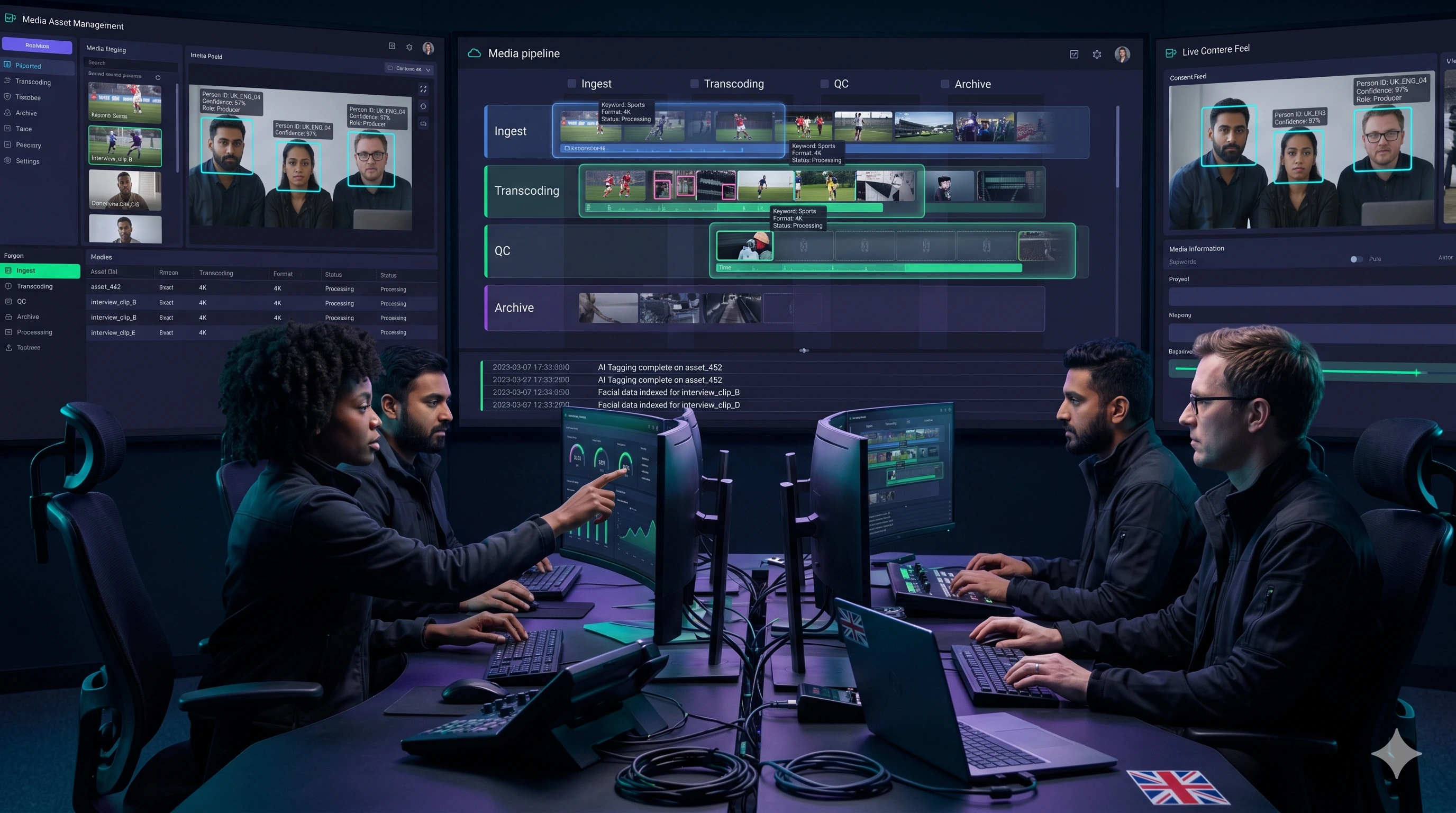
While DCM governs structured content, media asset management focuses specifically on rich media workflows, including:
Video ingestion and transcoding
Proxy generation for editing
Timecode-based metadata tagging
AI-assisted transcription and indexing
MAM platforms centralize large media files and enable collaboration while maintaining performance and manageability at scale.
At an enterprise level, digital content management (DCM), digital asset management (DAM), and media asset management (MAM) function as complementary layers within a unified content ecosystem.
DCM serves as the orchestration layer, governing how structured content is created, managed, and distributed across channels.
DAM focuses on organizing and controlling access to brand and marketing assets such as images, documents, and design files.
MAM specializes in processing and managing complex, time-based media like video and audio, supporting advanced workflows such as transcoding, metadata tagging, and collaborative editing.
In modern UK enterprise architectures, these systems are increasingly decoupled yet interconnected via APIs, enabling organizations to scale content operations, automate workflows, and deliver consistent omnichannel experiences without performance bottlenecks.
| Feature | Primary Function | Enterprise Role |
|---|---|---|
| DCM | Content lifecycle & distribution | Omnichannel delivery |
| DAM | Marketing asset storage | Brand governance |
| MAM | Video/audio pipelines | Media production & streaming |
Key insight:
DCM orchestrates delivery across channels
DAM fails at scale for video
MAM solves production complexity
Modern UK enterprise stacks are API-first:
GraphQL-powered content delivery
Edge-optimized APIs for global performance
Frontend flexibility (Next.js, mobile apps, OTT)
This architecture enables:
Faster deployment cycles
Personalization at scale
Device-agnostic content reuse
At scale, metadata drives discoverability.
Advanced MAM systems integrate:
AI tagging (objects, faces, scenes)
Speech-to-text transcription
Automated categorization pipelines
These workflows transform raw media into searchable, structured assets, critical for enterprise efficiency.
UK enterprises must comply with:
GDPR data governance
Audit trails and content lineage
Access control policies
Modern DCM + MAM systems enforce:
Role-based access control (RBAC)
Version control workflows
Approval pipelines
This ensures content integrity, regulatory compliance, and operational consistency.
In headless CMS systems:
Content is structured via schemas
Media assets link via dynamic references
APIs deliver composable content blocks
This approach supports:
Reusability
Localization (UK-specific markets)
Cross-channel consistency
Modern enterprise stacks rely on:
CDN-based edge delivery
Cloud-native storage (AWS, GCP, Azure)
Serverless compute pipelines
Benefits include:
Reduced latency
Global scalability
Cost optimization
Legacy systems suffer from:
Local storage limitations
Slow file transfers
Collaboration friction
Cloud-native MAM solves this through:
Distributed storage layers
Streaming-based access
Proxy file workflows
This enables real-time collaboration across distributed teams.
A modern stack may include:
Headless CMS (ie DatoCMS)
AWS Elemental Media Services
AWS Rekognition for AI metadata
This enables:
Automated enrichment on upload
Real-time indexing
Seamless content workflows
High-value integrations include:
iconik → cloud-native media collaboration
base® Media Cloud → UK-based production infrastructure
These partnerships accelerate deployment and reduce engineering overhead.
A complete DCM system includes:
Creation & Acquisition
Organization (metadata & taxonomy)
Distribution (multi-channel publishing)
Maintenance & lifecycle control
This structured lifecycle ensures:
Content consistency
Discoverability
Long-term governance
Streaming pipelines
Broadcast workflows
Large-scale video libraries
Secure content governance
Document + video integration
Compliance workflows
Omnichannel product content
Personalized media delivery
Real-time merchandising
Universal Equations approaches DCM + MAM through:
Immutable data modeling
API-first design
Scalable microservices
End-to-end observability
Debuggable pipelines
Data lineage tracking
Edge-optimized delivery
High-throughput processing
Cloud-native execution
Digital content management governs the full content lifecycle
Media asset management specializes in video/audio workflows
Headless architectures enable omnichannel delivery
AI-driven metadata is critical for scale
Cloud-native systems eliminate infrastructure bottlenecks