Transform your org with innovative, secure, cloud-native AI solutions today.. CONTACT US
Master your digital transformation in Île-de-France. Explore how a modern cloud service like Heroku accelerates cloud native development, from PaaS to microservices.
Founder
August 14, 2026
In the fast-paced tech hub of Île-de-France, enterprises are rapidly adopting cloud computing paradigms to scale their operations and maintain a competitive edge. Understanding the hierarchy of a fournisseur de services cloud (cloud service provider) is critical for strategic decision-making.
The primary types of cloud computing include:
IaaS (Infrastructure as a Service): Involves the rental of basic virtual servers and networks.
PaaS (Platform as a Service): Provides a ready-to-use platform specifically designed for creating and deploying programs.
SaaS (Software as a Service): Offers direct access to online software via a standard web browser.
While global hyperscalers like Google Cloud, Amazon Web Services (AWS), and Microsoft Azure dominate the broader market, local European powerhouses based in France, such as OVHcloud, provide robust regional alternatives for compliant, sovereign infrastructure.
For startups and agile enterprises in Paris and the broader Île-de-France region, speed to market is paramount. Heroku offers an unparalleled developer experience that accelerates launch cycles. However, as these companies mature and face stringent European data sovereignty laws (like GDPR and SecNumCloud certifications), hybrid approaches become necessary. It is common to see engineering teams rapidly prototype and launch on Heroku, before eventually integrating localized bare-metal or sovereign cloud solutions like OVHcloud for highly sensitive, regulated data components.
Transitioning to a cloud native approach is more than just moving servers to a data center; it is a fundamental methodology for creating agile, resilient software that adapts to dynamic variations in traffic.
The technological pillars of this approach include:
Microservices: Dividing an application into small, independent, and loosely coupled services that communicate with each other.
Containers: Packaging application code together with its dependencies so it can run identically anywhere, heavily relying on orchestration tools like Kubernetes.
Serverless (Sans serveur): Executing application code without the need to directly manage the underlying servers.
Because a microservice's failure does not result in the complete shutdown of the global system, this architecture guarantees extreme resilience and enables frequent, zero-downtime updates.
At Universal Equations, we frequently bridge these cloud platforms with robust, strongly typed backend systems. Whether you are mastering Kotlin lists for JVM microservices or leveraging the key improvements and features in Scala 3 to handle complex financial data pipelines, deploying these JVM-based containers to a cloud service like Heroku guarantees that your architectural rigor translates directly into seamless scalability.
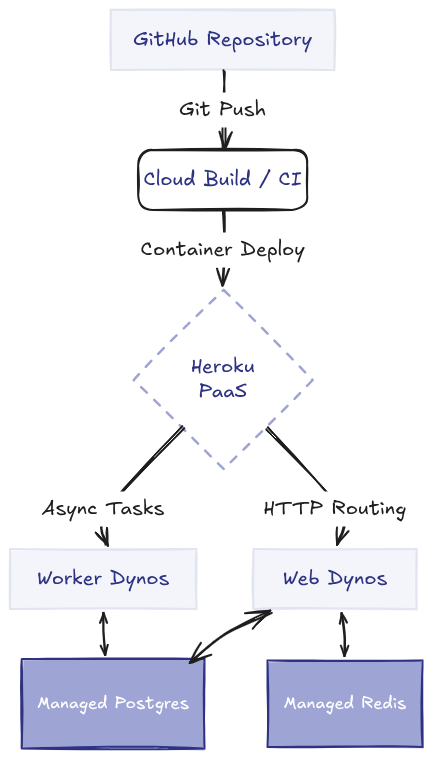
Heroku represents the pinnacle of the PaaS model. It bridges the gap between complex server infrastructure and rapid application deployment, making it a highly attractive option for enterprises prioritizing speed and developer experience.
No Server Management: Developers can deploy web applications directly to the cloud without having to worry about managing the underlying servers.
Container-Focused Execution: Heroku is heavily focused on containerized deployments, aligning perfectly with modern cloud native principles.
Business Logic Focus: By acting as a managed service, the platform allows clients and development teams to concentrate entirely on their code and business logic rather than DevOps overhead.
To truly understand the power of Heroku for cloud native development, consider how easily it handles modern, high-throughput languages like Go. In a microservices architecture, your application must dynamically bind to the port assigned by the cloud environment. Below is a live, interactive Golang snippet demonstrating a production-ready HTTP server configured for Heroku's dynamic routing. Feel free to modify and run it directly in your browser.
At Universal Equations, the core mission is Modernizing the Human Experience. We believe that technology should serve people, scaling complex backend digital infrastructure to power intuitive, impactful digital products.
Our approach to cloud infrastructure focuses on three distinct pillars:
Architectural Rigor: We design "correct-by-design" systems using microservices, Scala, Java, Golang, Kotlin, and Typescript to ensure your backend can scale infinitely.
Multi-Cloud Strategy: Whether integrating with AWS, GCP, Azure, or utilizing PaaS solutions like Heroku, we refine efficient resource management.
Containerization Mastery: We ensure seamless, resilient deployments via Kubernetes (GKE/EKS) and Red Hat OpenShift, actively reducing technical debt and operational overhead.
By treating cloud environments and microservices as data carriers across system boundaries, we help businesses in Île-de-France and beyond turn raw data into rapid, human-centric decisions.
Ready to modernize your infrastructure? Whether you are looking to deploy a new microservices architecture on Heroku, or need to untangle a complex multi-cloud environment, our engineers are ready to help.