Transform your org with innovative, secure, cloud-native AI solutions today.. CONTACT US
Master the HTML form action attribute. Learn secure configuration, relative vs absolute URLs, and mapping to index.html within Canadian PIPEDA compliant architectures.
Founder
July 19, 2026
While standard guides cover the basic syntax, Universal Equations approaches form configuration through the lens of Zero Trust architectural rigor. Whether you are submitting to a Java Spring Boot microservice or a headless Adobe Experience Manager (AEM) endpoint, the relationship between your frontend layout (index.html) and your action URL must be precise, secure, and computationally efficient.
In Canada, enterprise data must be handled with specific operational visibility. Misconfiguring a form action isn't just a bug; it's a potential data sovereignty cross-border variance. Standardizing how forms submit data enables:
Regulatory Compliance: Enforcing HTTPS endpoints within Canada for PIPEDA compliance.
Operational Cost Control: Efficiently routing data reduces ingress/egress cloud spend on platforms like GCP or Azure.
The syntax is straightforward, but the implementation defines system integrity.
<!-- Basic structure residing in index.html -->
<form action="/api/v1/canadian-customer-data" method="post">
  <!-- Interactive Controls -->
</form>
(For a foundational review of how the action attribute dictates form submission paths, see our complete guide on The HTML Form's Action Attribute.)
Option 1: Relative URLs (Recommended for Microservices)
Relative URLs (e.g., action="/submit") are preferred for seamless interaction within a single domain. They are computationally efficient and essential for CI/CD pipelines moving through development, staging, and production environments.
Option 2: Absolute URLs (Cross-Platform Integration)
Absolute URLs (e.g., action="[https://api.uequations.ca/submit](https://api.uequations.ca/submit)") are necessary when the frontend on index.html is decoupled from the backend analytics engine, or when integrating with third-party MarTech like Salesforce or HubSpot.
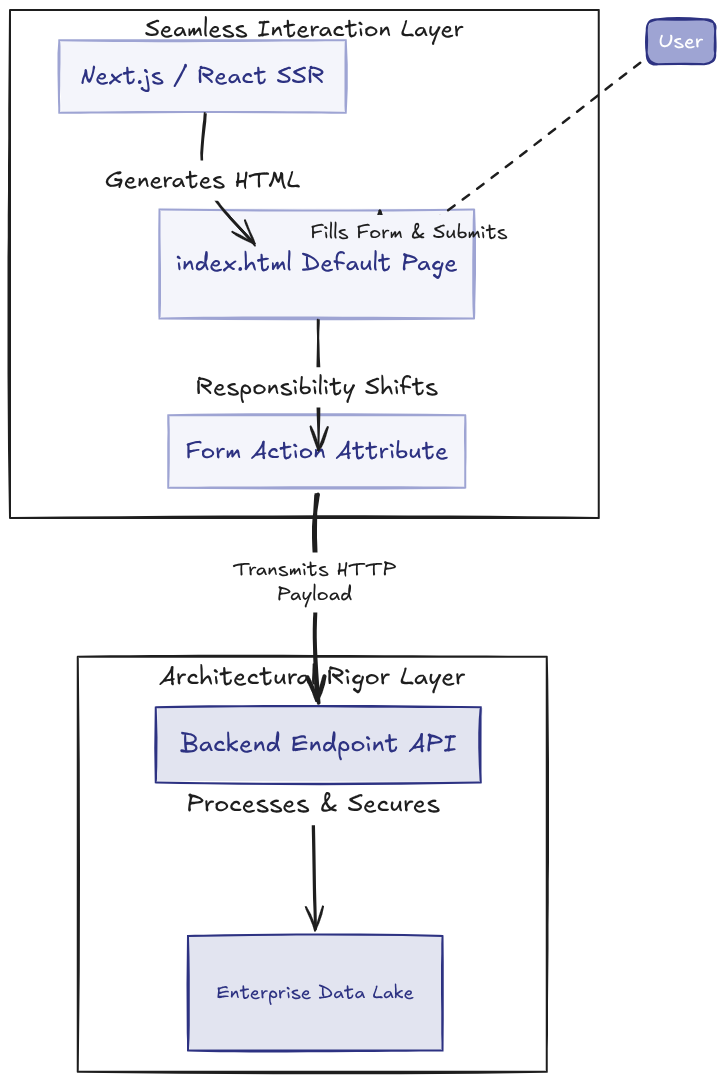
In almost all web server directory indexing configurations, index.html is served as the default page. When we discuss this, we are analyzing how the initial 'Seamless Interaction' layer (the rendered HTML document) maps mathematically to the 'Architectural Rigor' of the backend.
Consider a standard Next.js or React application generated via SSR. The client receives an index.html file. The moment a Canadian user clicks 'Submit', the responsibility shifts from that index.html to the protocol and URL defined in the action attribute.
Per our standardizing of engineering toolchains, we utilize Golang for high-throughput, PIPEDA-compliant data ingestion microservices. Below is an interactive simulation of how an enterprise Go backend processes an incoming request triggered by an HTML form action.
Understanding HTML form action is simple—but operationalizing it within a secure Canadian enterprise architecture requires rigor. The companies that win in 2026 are not just creating forms; they are modernizing the interface between humans and data by architecting friction-free, compliant, and computationally precise ingestion pipelines.