Transform your org with innovative, secure, cloud-native AI solutions today.. CONTACT US

Founder
June 24, 2026
The global enterprise technology landscape is undergoing a monumental shift. The standard monolithic, all-in-one platforms of the past decade can no longer keep pace with the demand for omnichannel, hyper-personalized, real-time digital experiences. This realization has recently culminated in a transformative market event: Salesforce, the world’s leading CRM, has signed a definitive agreement to acquire Contentful, the pioneer of the composable, headless content platform.
This acquisition is not merely a tactical integration; it is a strategic signal. It confirms that the future of customer engagement lies at the intersection of structured customer data and structured, modular content. For Universal Equations clients, this merger provides a native pathway to bridge the gap between their Data 360 and Content layers, but it also creates an immediate need for sophisticated architectural orchestration to realize its full potential.
Contentful is not a traditional website builder. It is a leading headless content management system (CMS) designed for the API-first era. To understand its power, we must first define "headless architecture."
In a traditional or "monolithic" CMS (like a standard WordPress implementation), the backend where content is managed (the body) is tightly coupled to the frontend presentation layer where the content is displayed (the head). A headless CMS decouples these two parts.
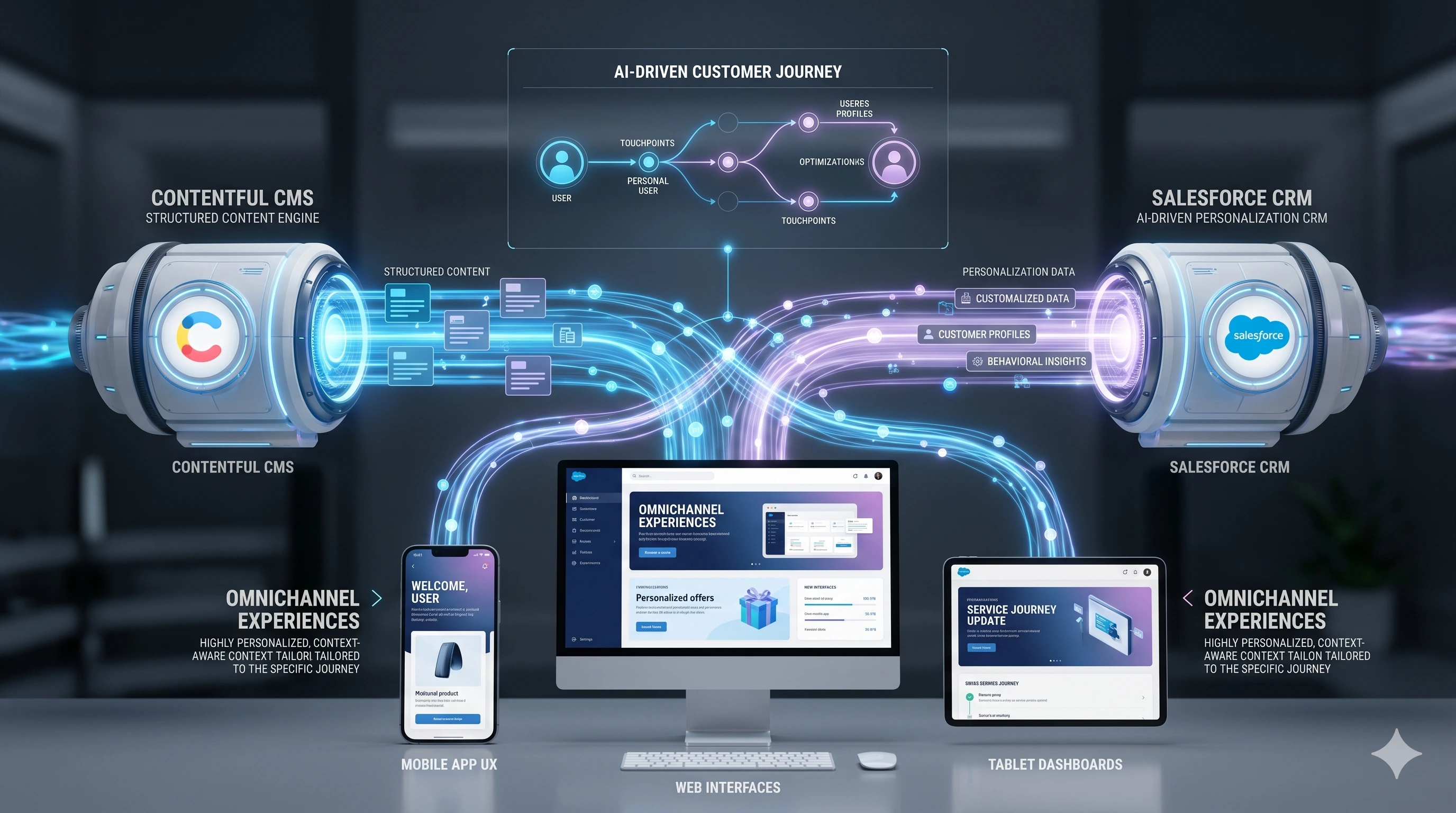
How Contentful Works: Contentful provides a robust, centralized hub where content is created, managed, and organized as structured data rather than static pages. This content is then delivered dynamically to any digital endpoint—websites, mobile apps, voice assistants, or smart devices—via powerful APIs (REST and GraphQL).
The Benefits of This Shift:
Create Once, Publish Everywhere (COPE): Editors define content models once, and the content can be reused seamlessly across different channels, maintaining brand consistency.
Developer Freedom: Your frontend team is no longer limited by the CMS's rigid templates. They can use the most modern technologies (like Next.js, React, or Vue) to build high-performance, custom user experiences.
Scalability: The decoupled nature allows the content delivery backend to scale independently of the frontend user traffic.
The acquisition of Contentful by Salesforce addresses the critical "missing link" in the Salesforce Customer 360 ecosystem. While Salesforce is unmatched at managing customer relationships and analyzing behavioral data, it previously lacked a native, enterprise-grade engine for managing the content that drives those interactions.
By bringing Contentful’s composable architecture into the fold, Salesforce will enable a unified, intelligent, and real-time marketing and commerce stack:
Dynamic, AI-Driven Orchestration: Contentful’s structured content will become directly accessible to Salesforce's AI orchestration engine, Agentforce. This will allow AI agents to dynamically query, assemble, and deliver personalized experiences—like unique landing pages or personalized offers—based on a customer’s real-time context, language, and behavior, without manual publishing bottlenecks.
A Content Layer for Customer 360: This merger allows organizations to pair trusted customer data with trusted content context, ensuring that every automated customer interaction is not only highly personalized but also brand-compliant, localized, and contextually accurate.
For enterprises in the highly competitive and fast-paced New York City market, adapting to this new reality is not optional; it is a competitive requirement. Your customers expect consistent, intuitive, and personal interactions, regardless of the device they are using. If your technology architecture remains monolithic, you cannot meet these expectations at scale.
The NYC Imperative to Modernize:
Eliminating Silos: NYC organizations often maintain separate teams and workflows for web, mobile, email, and commerce content. A modern, headless architecture with Contentful centralizes these workflows, eliminating fragmentation that erodes brand consistency and slows time-to-market.
Unlocking AI Potential: Without structured content that an AI agent can read and trust, your investment in Salesforce Agentforce or other AI tools cannot reach full maturity. An API-first architecture is the prerequisite for AI-driven personalization.
Future-Proofing Your Business: Monolithic architectures create technical debt that makes upgrading difficult and adopting new channels impossible. A decoupled, composable architecture ensures that your digital presence is built on an adaptable foundation that can integrate future innovations without a complete rewrite.
The convergence of Contentful and Salesforce represents the future of the enterprise digital experience. However, the path to realizing this unified vision requires sophisticated engineering, data orchestration, and cloud infrastructure modernization. Universal Equations is uniquely qualified to design the scalable, correct-by-design architectures needed to bridge these systems and drive meaningful digital transformation for our NYC enterprise clients.
At Universal Equations, we don’t just implement tools; we design resilient systems. As Salesforce moves to integrate Contentful natively within the Customer 360 ecosystem, the promise of "composable" architecture—where specialized services are seamlessly combined—becomes more powerful than ever. But simplicity on the surface requires sophisticated engineering underneath.
We architect composable ecosystems where Contentful handles the structured content and Salesforce manages the customer truth. Our approach moves beyond vendor-provided "plug-ins" to design custom, API-first integration layers that treat your content and your data as first-class citizens, ensuring flexibility, stability, and speed.
The true power of this modern stack is unlocked when machine-readable customer context meets machine-readable structured content. While Salesforce Knowledge has historically served as a repository for governed text blobs, Contentful organizes content as discrete fields (e.g., product title, localized description, warranty duration, imagery variants) with strong schemas.
Our engineering team bridges these two worlds. We specialize in mapping Salesforce CRM schemas—including Customer 360 data from Data Cloud—directly into Contentful’s structured content models. By organizing content as field-level data rather than static blobs, we enable AI engines like Agentforce to precisely query, trust, and retrieve approved asset fragments. We build the pipelines that allow a machine to read the current stock status from Salesforce and dynamically assemble it alongside the correct, approved marketing copy from Contentful, entirely on-the-fly.
Traditional monolithic systems suffer from tight coupling, where a change in the content database can require a full rebuild of the presentation layer. Monoliths are forced into real-time server-side assembly, creating massive rendering bottlenecks during peak NYC traffic. They deliver heavy, unnecessary "blobs" to the client.
We design architectures that use API-first principles to eliminate these bottlenecks:
Decoupled Rendering: Our engineers separate the content management domain (Contentful) from the experience rendering domain. We prioritize delivering content like data—small, specific GraphQL payloads—allowing your frontend infrastructure to scale independently of your CMS.
Edge Caching: API-first delivery allows us to aggressively cache deterministic API responses at the CDN and edge locations, reducing the processing load on the core systems.
Faster UX Iteration: By defining clear API contracts between the backend content and frontend teams, designers can modernize web and mobile interfaces without destabilizing your core customer data or content governance.
Omnichannel personalization has historically been labor-intensive, relying on human marketers to manual create segment-specific content variations. Composable architecture makes automation possible by removing manual publishing bottlenecks.
Universal Equations empowers you to achieve omnichannel personalization at enterprise scale through:
1:1 AI-Driven Orchestration: By ensuring Contentful content is organized as structured data fields, we enable Salesforce’s autonomous agents (Agentforce Marketing Outcomes) to query, recompile, and deliver 1:1 personalized combinations of messaging, imagery, and products based on the real-time behavioral insights captured in Salesforce CRM.
Operational Visibility: When architectures become modular, observability becomes critical. We build comprehensive monitoring into the evolving system to track API health, response times, and personalized journey errors, allowing you to iterate on user experiences confidently.
Low Exit Cost: A genuinely composable stack ensures you are never captive to a single monolith. By engineering interoperability at the API level, we build systems with low switching costs, allowing you to swap out individual components as new technologies emerge.
An elegant content model requires robust middleware and well-architected connection points to achieve operational viability. Instead of relying on fragile, generic plugins that introduce security risks and latent database calls, enterprise networks demand direct, decoupled integration patterns. By strategically connecting your content and transactional engines, your digital properties transition from rigid presentation frameworks into high-performance, edge-optimized commerce platforms.
In an omni-channel ecosystem, product metadata must live in harmony with editorial storytelling. Monolithic frameworks traditionally struggle with this, forcing teams to copy and paste product IDs, descriptions, and SKUs across disparate systems. Bridging this operational gap requires a dedicated schema integration.
By leveraging the Salesforce Commerce Cloud Connector, engineering teams can bridge the relational divide between transactional databases and the headless CMS. This integration exposes real-time Salesforce B2C product catalogs and category taxonomies directly within the content editing workspace. Instead of hardcoding text values, content editors map structured content entries directly to dynamic product IDs fetched straight from the commerce core. This prevents data drift, automates stock-level consistency, and allows marketing teams to inject shoppable components into rich editorial landing pages seamlessly.
The client-facing runtime architecture dictates the ultimate success of an enterprise platform. High-traffic systems operating within dense, fast-moving markets cannot tolerate client-side latency or heavy javascript payloads. The answer lies in an optimized frontend framework that maps natively to API-driven data structures.
By pairing Contentful CMS with an edge-optimized framework like Next.js, you decouple experience assembly from core database processing. Universal Equations deploys a decoupled architectural framework that capitalizes on modern rendering strategies:
Server-Side Rendering (SSR) & ISR: We utilize Incremental Static Regeneration (ISR) to pre-render static HTML pages at build time, pulling content parameters directly from GraphQL schemas.
Edge-Cached Delivery: When modifications occur inside Contentful, on-demand webhooks invalidate the static cache selectively, propagating fresh content to edge CDNs instantly without requiring a full application redeployment.
Granular API Fetching: Utilizing compact GraphQL fragments ensures that the Next.js frontend layer requests the exact fields specified by the content model, drastically minimizing network overhead and improving mobile vitals.
Expanding an enterprise footprint into international markets or localized regional campaigns often introduces massive operational complexity. Content teams frequently end up trapped in repetitive translation cycles, copy-pasting values across localized instances and destabilizing core layout rules.
A composable architecture solves this localized bottleneck through automated translation workflows. Modern content platforms rely on deep-stack API bridges (such as connecting your headless CMS to dedicated translation networks like Lokalise or Salesforce's global translation engines) to handle localized content logic programmatically. When a new product blueprint or marketing copy block is approved in the primary language, a webhook automatically extracts the structured content fields, transmits them to the localization protocol, and streams the validated translations directly back into the corresponding language locales. This automated orchestration eliminates translation silos, reduces time-to-market for global rollouts from months to minutes, and preserves complete architectural rigor across every regional endpoint.
At Universal Equations, we approach digital transformation not as a design exercise, but as a rigorous engineering discipline. The integration of a headless CMS like Contentful with an enterprise CRM like Salesforce requires more than just connecting API endpoints; it demands a robust, composable ecosystem built for scale. Our methodology bridges the gap between complex backend engineering and seamless human interactions, ensuring that your technology serves your people—not the other way around.
Our foundational brand pillar is Architectural Rigor. We engineer "correct-by-design" systems that scale infinitely and fail gracefully. When integrating Contentful and Salesforce, we rely on strict structural engineering rather than fragile, ad-hoc integrations.
By leveraging end-to-end type safety with TypeScript and automated GraphQL code generation, we ensure that the data schemas defined in your headless CMS align perfectly with your Next.js presentation layer. This methodology eliminates runtime payload errors, prevents data drift between your CRM and your content repository, and ensures that the composable architecture remains mathematically precise across every deployment environment.
A decoupled architecture distributed across Salesforce, Contentful, and edge networks inherently introduces new operational complexities. To combat this, we prioritize Operational Visibility—providing deep, real-time insights into data flows, cloud spend, and overall system health.
Our enterprise architectures incorporate advanced observability pipelines to monitor API latency, track event-driven data exchanges, and pinpoint synchronization failures before they impact the end user. Furthermore, by deploying these integrations via isolated, containerized environments like Docker on Google Cloud Run, we guarantee that your headless infrastructure remains secure, compliant, and highly performant under peak NYC traffic loads.
Migrating from a monolithic legacy system to a modern, API-first stack requires a calculated and risk-averse transition strategy. Our proprietary "Equation" Methodology begins with Variable Analysis, where we systematically audit your existing technical debt and identify human friction points within your current CMS and CRM workflows.
From there, we execute a strategy of Human Modernization. We deploy solutions that incrementally improve ROI and editorial efficiency without requiring a disruptive "rip-and-replace" event. Through a focus on Seamless Interaction, we modernize the interface between your users and your data, ensuring that the transition to a headless Salesforce and Contentful ecosystem is completely invisible to your customers but fundamentally transformative for your enterprise.